

TTC Green Initiatives
TTC Green advances initiatives that reduce greenhouse gas emissions, strengthen resilience to extreme weather, promote responsible resource use, and enhance biodiversity, while continuing to deliver safe, reliable transit service.
The Innovation and Sustainability Strategy outlines how the TTC will better serve customers, reduce its environmental impact, and strengthen our operations to withstand extreme weather events.

The TTC continues to modernize its service, and sustainability initiatives are essential to that process. We are working towards a zero-emissions fleet that will maintain safe, reliable service, while decarbonizing facilities and operations to support a greener future.
-
Electric Buses

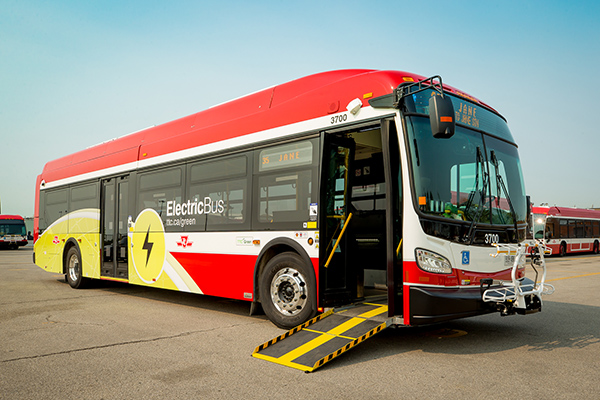
The TTC’s Green Bus Transformation Program is transforming the future of transit in Toronto. As one of the largest electric bus initiatives in North America, it is accelerating the shift to clean, quiet, zero-emissions mobility across the city. At the end of 2025, the TTC had 206 eBuses – approximately 13% of the bus fleet – and is on track to have 336 eBuses in service by mid-2026, supported by new charging infrastructure.
For customers, this means more electric buses on more routes, delivering smoother, quieter trips while reducing air pollution and noise in the neighbourhoods they travel through. For the city, it marks a major step toward a modern, climate-ready transit network built for the future.
This transition is essential. Diesel buses account for more than 79.5% of the TTC’s direct and indirect greenhouse gas emissions. With the streetcar and subway fleets already fully electrified, the Green Bus Transformation Program represents the single most impactful action the TTC can take to cut emissions and support Toronto’s climate goals.
-
Electric bus charging
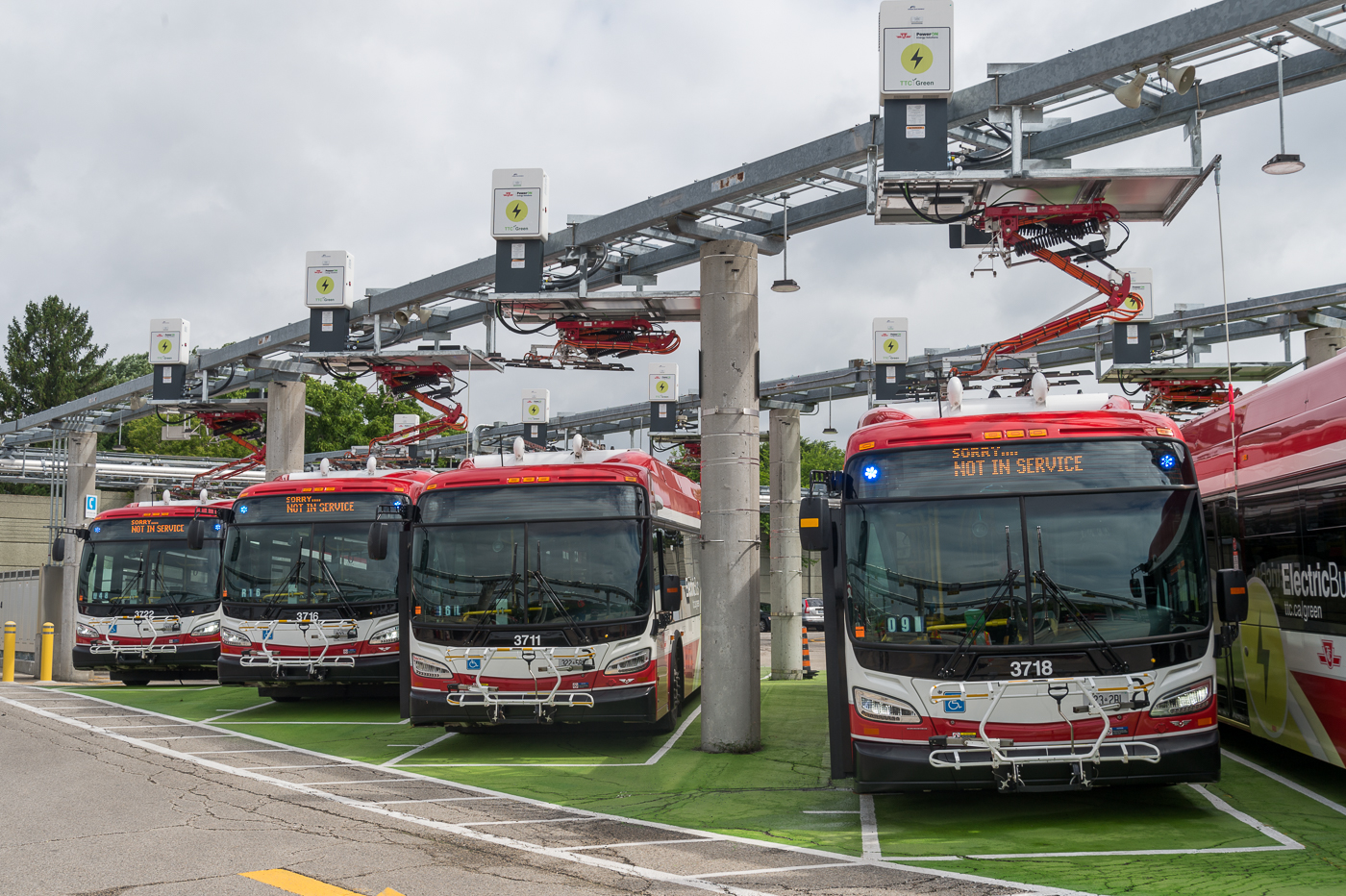
Currently, charge points are installed across seven bus garages. A total of 298 charge points will be in place by the end of this year to support the TTC’s growing eBus fleet.
Charger technology continues to evolve, and the TTC is on the leading edge. Our phased installation allows us to install new chargers with twice the power output as the ones installed in 2019.
-
Hybrid Buses

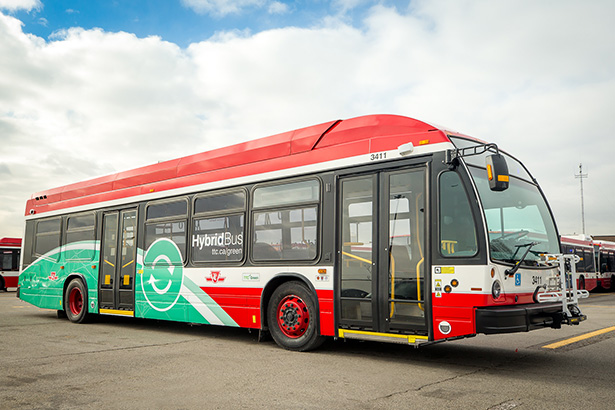
Hybrid buses are an important step toward full electrification, as they help us transition our fleet to lower emissions technology while ensuring we are still able to offer the service our customers rely on. The TTC’s bus fleet is almost 30 per cent comprised of hybrid buses.
Fast Fact!
TTC’s hybrid-electric buses can operate in electric vehicle mode when they enter one of 130 pre-identified Green Zones within the city, a station, or a garage, reducing both air and noise pollution. -
Electric Wheel-Trans fleet
The TTC is evaluating battery-electric alternatives for Wheel-Trans vehicles by procuring and testing five all-electric Wheel-Trans buses. The vehicles are expected to be in service for testing in 2026. The goal is to have a fully electric Wheel-Trans fleet before 2040, in alignment with TransformTO.
Through this energy transition, our primary goal remains to provide a fully accessible vehicle that meets the needs of our customers. As such, the Advisory Committee on Accessible Transit (ACAT) will be a key evaluator for new electric Wheel-Trans buses.
Fast Fact!
Our last diesel Wheel-Trans bus was decommissioned in 2023. As the fleet transitions from diesel to gasoline to battery-electric, the total GHG emissions intensity decreases. With an electric Wheel-Trans fleet, the GHG emissions intensity is anticipated to be reduced to approximately a quarter of the emissions of an average personal non-electric vehicle. -
LED Lighting Retrofit
As of 2025, all subway station platforms have been successfully retrofitted with energy-efficient LED light bulbs. Between 2019 and 2025, the TTC has replaced approximately 58,000 light bulbs across the system.
-
Green Roofs
.jpg?h=auto&w=100%25&rev=53a907b19b7f4f048b50990c9ca1c0c8&hash=090D7E2D683BB362B8FE353D2C1AC702)
Green roofs are roofs of buildings that are covered either partially or completely with a thin layer of vegetation. They offer benefits such as air purification, stormwater runoff control, energy load reduction, and habitat creation.
The TTC’s first green roof was installed at Cedarvale Station, which contains a 1,085-square-metre garden. Since then, the TTC has implemented green roofs at 13 of its facilities including:
- Downsview Park Station
- Finch West Station
- York University Station
- Pioneer Village Station
- Vaughan Metropolitan Centre Substation
- Victoria Park Station
- Dufferin Station
- McNicoll Bus Garage
- Leslie Barns Carhouse
- Roncesvalles Carhouse
- Wilson Carhouse
- Hillcrest Complex’s Streetcar Way Building
- Cedarvale Station
-
Fast facts
- In 2025, the TTC initiated its first facility HVAC decarbonization project at Greenwood Shop to reduce emissions and add cooling to support worker health and operational resilience.
- By switching from gas-powered to electric hand tools, a TTC pilot program is expected to cut nearly 3 tonnes of CO2 emissions every year.