

Subway platform safety pilot at TMU Station
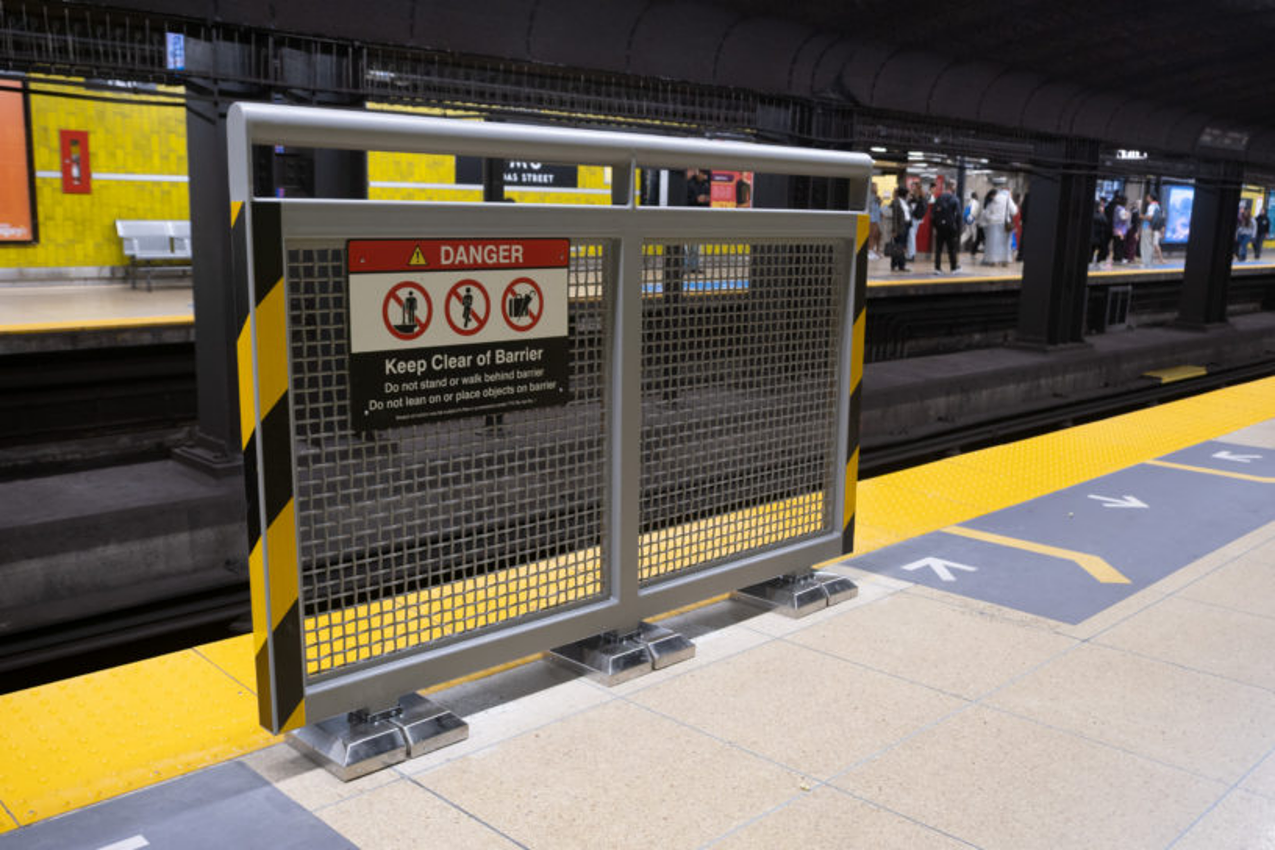
In May of 2026, the TTC unveiled a suite of measures that will enhance customers’ sense of safety. This includes a new multi-phase pilot program to reduce delays caused by people and objects at track level.
The pilot is now being rolled out at TMU Station and will include a period of consultation with customers, assessment and evaluation.
The pilot consists of two key elements:
Platform edge barriers
Based on an approach proven successful on New York City’s Metropolitan Transportation Authority (MTA), the 6.5 by 4.5-feet / 2.0 by 1.4-metre steel barriers are placed near the platform edge and between areas where subway doors open.
In New York, these barriers – up to nine per platform – have seen reductions in objects ending up on the tracks and brought customers an enhanced sense of safety while waiting on the platform. These barriers are not intended to replace full-height automated platform edge doors (PEDs).
To accommodate the installation of the first block of seven barriers per platform, some existing station furniture will need to be relocated. Additional barriers will be installed throughout September and into October 2026.
Camera-based track intrusion technology
To complement the barriers, the TTC will also pilot camera intrusion technology that will identify an individual on the tracks and immediately notify the Transit Control Centre.
This means marked improvements in two ways: quicker response times and faster recovery time.
Currently, when someone descends to track level, it requires a power cut and, in many cases, requires TTC staff to do a manual inspection to determine if it is safe to restart service. The cameras will allow for rapid response and reduced delays.
While PEDs offer the highest level of safety, they also present the greatest cost and implementation complexity. Together, sensor-based systems combined with platform safety barriers offer a lower-cost, faster-to-implement alternative to full platform edge doors. Though they do not fully prevent unauthorized track access, platform safety barriers enable faster implementation with minimal operational impact while enhancing customer perception of safety and confidence.
The TMU pilot is part of a suite of safety and security initiatives that will see the TTC:
- Increase staff visibility in stations and to conduct on-vehicle checks during peak hours, and fare inspection on subways at other times
- Improve deployment of provincial offences officers, Special Constables, station supervisors, and security guards to be more dynamic and data-informed
- Improve coordination of services for vulnerable people in need of social services or shelter, so they don’t have to shelter on transit overnight
- Expand the use of body-worn and in-station cameras to act as a deterrent to anti-social behaviour
- Pilot a targeted in-stations announcement system in key locations to reduce disruptive behaviour and delays
Read the full Advancing Safety on the TTC: 2026 Focus Areas report.
For more information, visit the subway platform safety pilot project page.